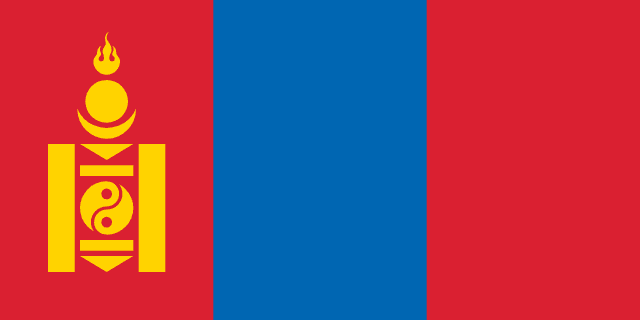

Mongolia
Asia
3,626,892
17:12 UTC+8
+976
.mn
Khuiten Peak
4,374 m · 14,350 ft
Hoh Nuur
518 m · 1,699 ft
1,697,349
Ulaanbaatar · 2026
1,697,349
Ulaanbaatar · 2026
Location
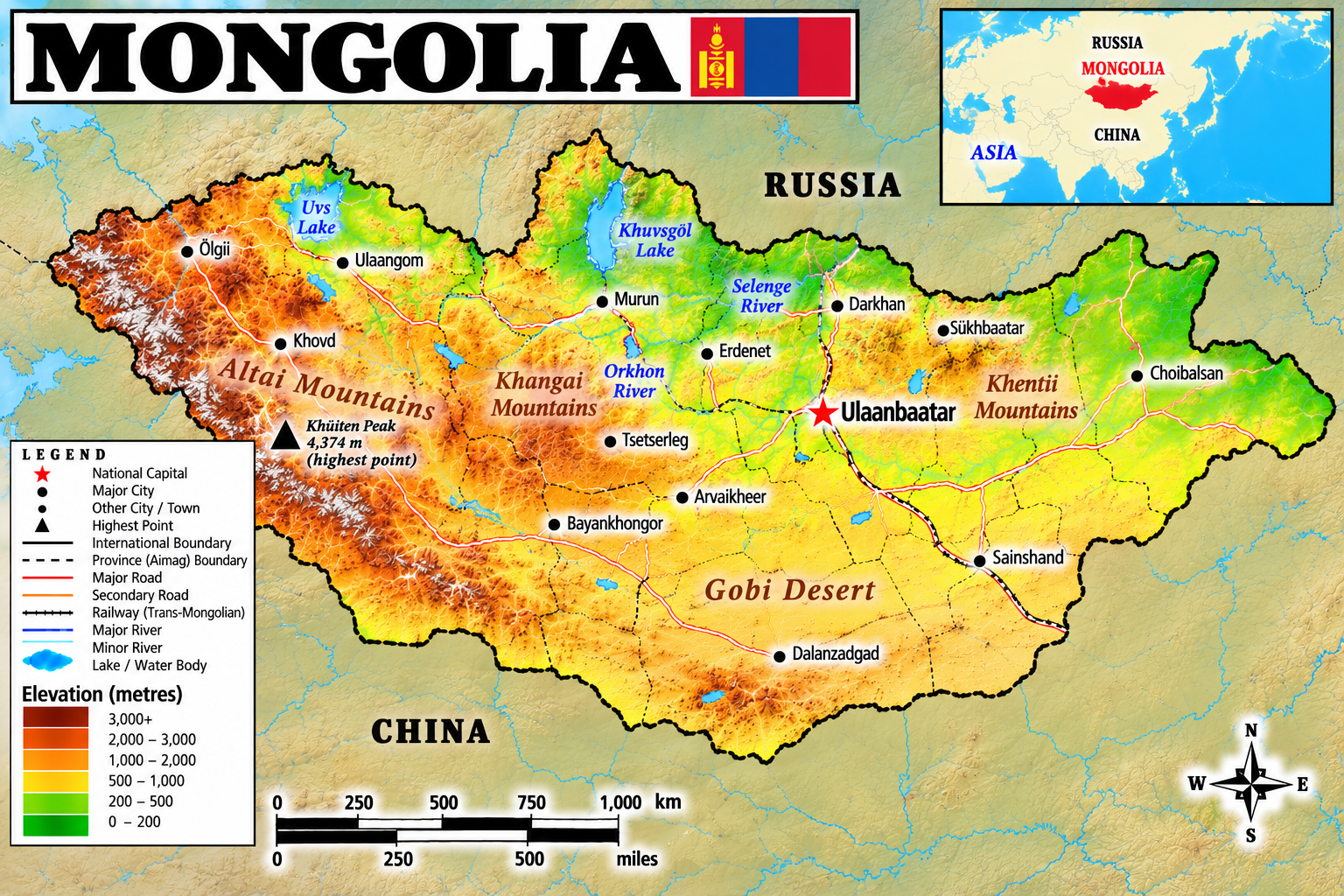
Mongolia — Detailed Physical Map
The Altai, Khangai and Khentii mountains, Khüiten Peak, the Gobi Desert, Uvs and Khuvsgul lakes, the Selenge and Orkhon rivers, aimag boundaries, major cities and the capital Ulaanbaatar
Tourist Attractions
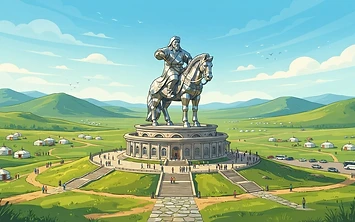
This massive 40-meter tall stainless steel statue depicts Genghis Khan on horseback and serves as a tribute to the founder of the Mongol Empire. Visitors can ascend to the horse's head for panoramic views of the surrounding steppes.
It is the largest equestrian statue in the world and an iconic symbol of Mongolia.
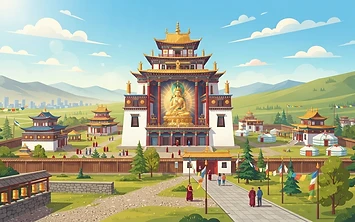
As the largest Buddhist monastery in Mongolia, this site is a center for daily religious ceremonies and spiritual life. It houses a magnificent 26.5-meter tall statue of the Bodhisattva Avalokitesvara.
The towering indoor Buddha statue is a breathtaking masterpiece of religious art.

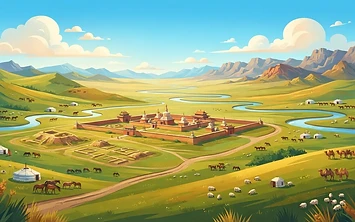
This UNESCO World Heritage site encompasses the ancient capital of Karakorum and archaeological remains dating back to the 6th century. It represents the evolution of nomadic pastoral traditions over two millennia.
It offers a profound look into the heart of the Mongol Empire and ancient Turkic history.

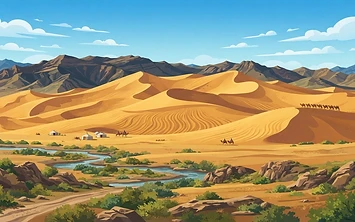
This vast national park features diverse desert landscapes, including the famous Khongoryn Els sand dunes, also known as the 'Singing Sands.' It is a premier destination for experiencing the harsh beauty of the Gobi Desert.
The shifting dunes create a unique acoustic phenomenon known as the singing sands.

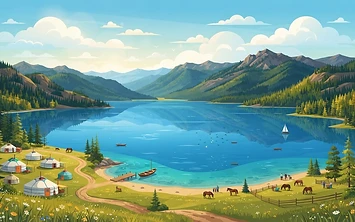
Known as the 'Blue Pearl of Mongolia,' this ancient lake is the largest in the country by volume and contains crystal-clear fresh water. It is surrounded by forested alpine mountains and is a haven for outdoor exploration.
The lake's stunning aquamarine waters offer some of the most scenic landscapes in the country.

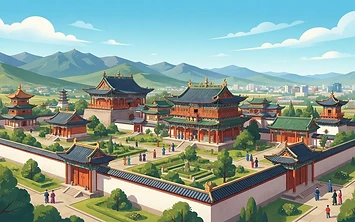
This complex was the winter residence of the eighth Bogd Khan, the last king of Mongolia, and survived the political purges of the 20th century. It houses a rich collection of royal regalia, Buddhist art, and personal artifacts.
It provides an intimate glimpse into the life and opulence of Mongolia's final monarch.
Geography
Nature
Khuiten Peak
4,374 m / 14,350 ft
8.3% of land
≈ 129,821 km² of forest
FAO / World Bank, forest area (% of land area)
Explore the Nature Atlas1,024 km636 mi
Rises in the Khangai Mountains and flows north into Lake Baikal.
1,254 km779 mi
Originates near the Burkhan Khaldun mountain and flows into Hulun Lake.
818 km508 mi
The birthplace of Genghis Khan is traditionally associated with this river basin.
3,350 km²1,293 sq mi · 22 m deep
The largest lake in Mongolia by surface area and a saline basin.
2,760 km²1,066 sq mi · 262 m deep
Holds nearly seventy percent of Mongolia's fresh water supply.
1,407 km²543 sq mi · 80 m deep
A deep saltwater lake located in the western part of the country.
20 m66 ft
Formed by volcanic activity and flows along the Ulaan River.
River lengths are whole-river figures, including any section beyond Mongolia. Researched reference figures. Tap any name for where its name comes from and a Google Maps link.
Major Cities
- 1Capital
Ulaanbaatar
1,682,6362026
MapServes as the political, economic, and cultural capital of Mongolia housing the majority of the nation's population and institutions.
- 2
Orhon
112,5202026
MapHosts one of the largest copper and molybdenum mines in the world driving a significant portion of national industrial output.
- 3
Bayanhongor
93,2762026
MapLocated at the transition zone between the Gobi Desert and the Khangai Mountains, facilitating regional trade and pastoral movement.
- 4
Darhan-Uul
93,0292026
MapDeveloped as a major industrial and agricultural center in the northern part of Mongolia during the socialist era.
- 5
Selenge
93,0292026
MapDeveloped as a major industrial and agricultural center in the northern part of Mongolia during the socialist era.
- 6
Dornod
52,1022026
MapOperates as the regional commercial hub for eastern Mongolia serving as a key center for the livestock industry.
- 7
Hövsgöl
51,7492026
MapFunctions as the primary transit hub and administrative center for tourism in the northern Khovsgol province near the lake.
- 8
Bayan-Ölgiy
47,5232026
MapMaintains a distinct cultural identity as the center for the ethnic Kazakh population and traditional golden eagle hunting festivals.
- 9
Ulaanbaatar
40,1462026
MapHistorically significant for its deep coal mining operations that fueled the development of the nearby capital city.
- 10
Hovd
38,7382026
MapExists as one of the oldest settlements in western Mongolia with a diverse population and long-standing historical trade ties.
- 11
Uvs
35,0002026
MapLies near the shore of Uvs Nuur lake acting as an agricultural center for the westernmost region of Mongolia.
- 12
Selenge
22,0002026
MapFunctions as a crucial border crossing and railway gateway connecting Mongolia with the Russian Federation to the north.
City populations are the latest official, UN or national-statistics estimates (2026–2026) compounded to 2026 at 1.5% a year (the nation's annual population growth rate); figures without a published update come from the open cities database (2020-era estimates) and are projected the same way.
Economy
Main exports
Mongolia's leading export commodities and products.
Tap any export to learn more. Spot prices in USD only for Live Data subscribers.
Main imports
Mongolia's leading import commodities and products.
Tap any import to learn more.
Military
Historical Timeline
50000 BCE
Early human habitation in Mongolia
Archaeological evidence suggests that early Paleolithic humans inhabited the region of modern-day Mongolia as early as 50,000 years ago. These early populations represent the ancestors of the diverse nomadic groups that would later inhabit the steppe.
209 BCE
Formation of the Xiongnu Empire
Modu Chanyu unified the nomadic tribes of the Mongolian plateau, establishing the first major nomadic confederation known as the Xiongnu Empire. This entity set the precedent for future nomadic state structures in East Asia.
1206
Unification of the Mongol Empire
Temujin was proclaimed Genghis Khan at a kurultai, unifying the Mongol tribes into a single state. This event marked the beginning of a rapid expansion that would create the largest contiguous land empire in history.
1260
Founding of the Yuan Dynasty
Kublai Khan assumed the title of Great Khan and later established the Yuan Dynasty in China. This era facilitated significant cultural and technological exchange across the Silk Road.
1691
Submission to the Qing Dynasty
The Khalkha Mongol leaders pledged allegiance to the Qing Dynasty during the Dolonnor assembly, bringing Mongolia under Manchu rule. This period of suzerainty lasted until the early 20th century.
1911
Declaration of independence
Following the collapse of the Qing Dynasty, Mongolia declared its independence under the Bogd Khan. This marked the restoration of Mongolian statehood after centuries of foreign administration.
1924
Establishment of the Mongolian People's Republic
Following the 1921 revolution, the Mongolian People's Republic was officially proclaimed with a constitution modeled on the Soviet system. The country entered a long period of close political and economic alignment with the Soviet Union.
1990
Democratic Revolution
Mass protests led to the end of the one-party communist rule and the introduction of a multi-party political system. This transition initiated the shift toward a market-oriented economy and democratic governance.
2021
Election of Ukhnaagiin Khürelsükh
Ukhnaagiin Khürelsükh was elected as the first President under the new constitutional amendments that limit presidents to a single six-year term. This reform aimed to stabilize the executive branch and prevent power consolidation.
2023
Establishment of the Oyu Tolgoi underground mine
Operations at the Oyu Tolgoi underground mine officially commenced, marking a significant milestone for Mongolia's mining-led economic development. This project is central to the nation's strategy for long-term fiscal growth.
2024
Parliamentary election and coalition government
Mongolia held its first parliamentary elections under a new, expanded electoral system that increased the number of seats in the State Great Khural. The result led to the formation of a rare multi-party coalition government.
2025
Adoption of the 'Vision 2050' development plan
The government finalized updated policy frameworks under the 'Vision 2050' long-term development agenda to diversify the economy away from mineral dependency. This policy serves as the primary roadmap for infrastructure and social development in the coming years.
National Anthem
Монгол улсын төрийн дуулал
Tsendiin Damdinsüren
Bilegiin Damdinsüren and Luvsanjambyn Mördorj
1950
Дархан манай тусгаар улс Даяар монголын ариун голомт Далай их дээдэс хийсэн бүтээсэн Далдын энэ тусгаар тогтнол Эртний үндэс нэгтэй монголчууд Эв санаагаа нэгтгэн бэхжүүлье Үтэр түргэн хөгжлийн төлөө Үүрд хамтдаа зүтгэцгээе Мандан бадарч монгол улс Өөдлөн дэвжээ хөгжиг
The current national anthem of Mongolia was officially adopted in 1950 during the socialist era. It was composed by Bilegiin Damdinsüren and Luvsanjambyn Mördorj, with lyrics written by the prominent poet Tsendiin Damdinsüren. The anthem replaced a previous version that had been in use since the 1920s following the Mongolian Revolution. Over the decades, the lyrics underwent minor modifications, specifically the removal of references to Stalin and the Communist Party in the early 1990s following the democratic transition. It remains a powerful symbol of Mongolian national identity, sovereignty, and historical resilience. The anthem is traditionally performed at state ceremonies, government events, and formal public gatherings throughout the nation.
National Holidays
This festival marks the first day of the first month of the lunar calendar and signifies the end of winter and the arrival of spring. It is a traditional time for family reunions, paying respects to elders, and performing rituals for prosperity.
This day is officially recognized to honor the social, economic, and political achievements of women in Mongolia. It is widely celebrated as a day to appreciate and show gratitude toward mothers, sisters, and female colleagues.
Established to promote the welfare, rights, and happiness of children, this day involves numerous public events and festivities across the country. It is a dedicated holiday focusing on the younger generation and their future development.
Naadam commemorates the 1921 Mongolian Revolution and celebrates national independence through the 'three manly games' of wrestling, horse racing, and archery. It serves as the most important cultural and national celebration, highlighting Mongolian history and nomadic heritage.
This date commemorates the proclamation of the Mongolian People's Republic in 1924 and the adoption of the country's first constitution. It marks the formal establishment of Mongolia as an independent state.
Good News Today
Mongolia successfully hosts UNCCD COP17 to drive global land restoration
Mongolia recently hosted the UNCCD COP17 conference, becoming the first nation in East and Central Asia to do so, with a focus on restoring degraded land and rangelands. The event resulted in multi-billion dollar financial pledges and the launch of new initiatives to support sustainable land management for pastoral communities.
Fun Facts
Land of The Eternal Horse
With a horse population that outnumbers the human population, the horse is central to the traditional nomadic lifestyle of the Mongolian people.
Known As Land of Blue Sky
Mongolia enjoys over 250 days of clear, sunny weather annually, earning it the poetic nickname, the 'Land of Eternal Blue Sky'.
Dinosaur Fossil Discovery Hotspot
The Gobi Desert is world-famous for the discovery of the first-ever dinosaur eggs, significantly altering scientific understanding of prehistoric life.
Traditional Ger Dwelling Architecture
The portable 'ger' (yurt) is a masterwork of nomadic engineering, designed to be assembled or taken down in less than an hour.
Naadam Festival Sports Excellence
The annual Naadam festival showcases the 'Three Manly Games': Mongolian wrestling, horse racing, and archery, which date back to the Mongol Empire.
Golden Eagle Hunting Tradition
In Western Mongolia, Kazakh nomads continue the ancient, awe-inspiring tradition of hunting foxes and hares using trained golden eagles.
Ulaanbaatar Is Coldest Capital
Ulaanbaatar holds the distinction of being the coldest capital city on Earth, with temperatures often plunging far below freezing in winter.
Mastery of Khoomei Throat Singing
Mongolian throat singing, or Khoomei, is a unique vocal technique where a performer produces two distinct pitches simultaneously.
Home to Bactrian Two-Humped Camels
The Gobi Desert is the native home of the rare Bactrian camel, a hardy species capable of surviving extreme temperature fluctuations.
Suutei Tsai Salty Milk Tea
The traditional drink of choice is 'suutei tsai,' a warm, salty milk tea that serves as a vital energy source for nomadic herders.
Chuckies Trivia Quiz
Chuckies Trivia Quiz
Fifteen questions on Mongolia — five easy, five medium, five hard. How far can you get?
Sports & Live Events
Language
Counting to 10
1
1
= 10 (n = 0)
World Dictionary
Discover and translate any word into all supported languages.