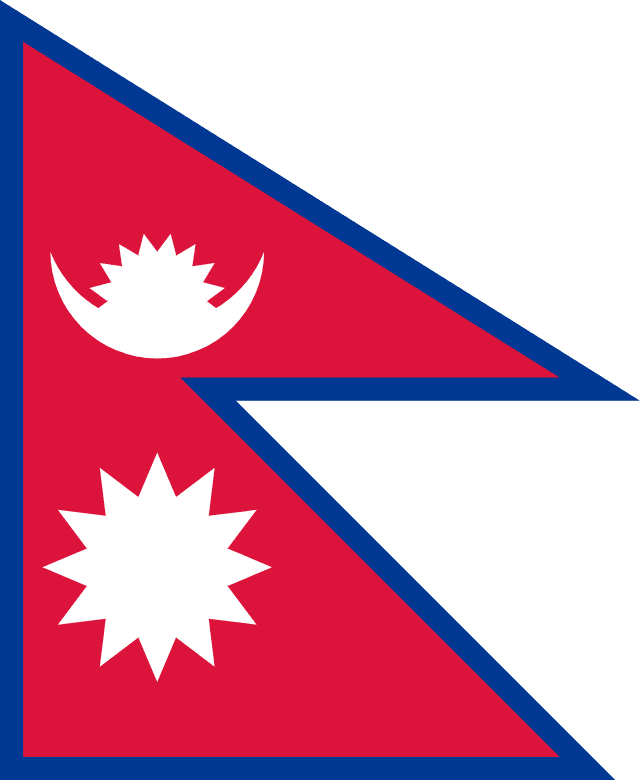

Nepal
Federal Democratic Republic of Nepal
Asia
30,293,378
10:07 UTC+5:45
+977
.np
Mount Everest
8,849 m · 29,032 ft
Kanchan Kalan
59 m · 194 ft
1,048,507
Kathmandu · 2026
1,048,507
Kathmandu · 2026
Location
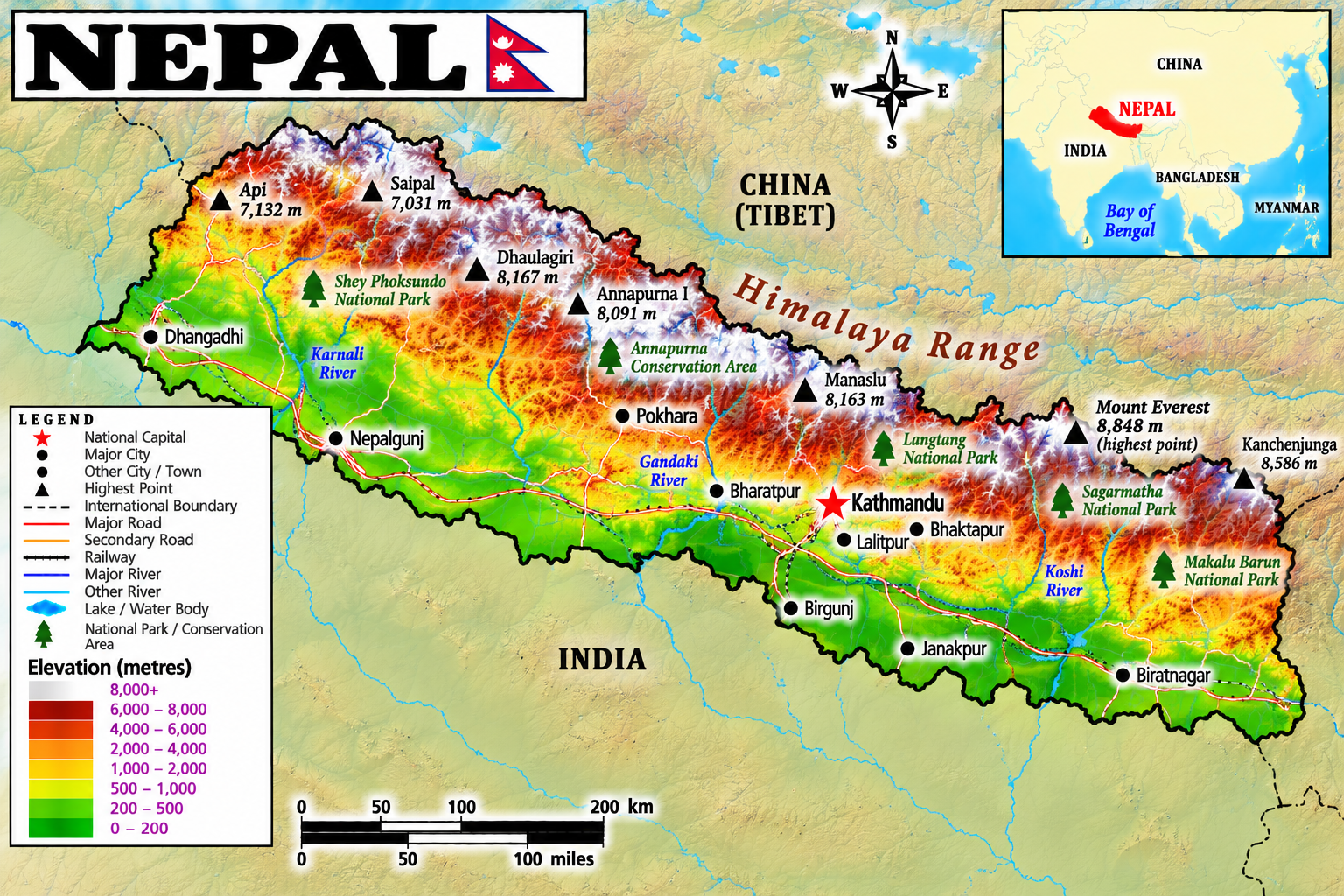
Nepal — Detailed Physical Map
The Himalaya Range from Api to Kanchenjunga, Mount Everest, Annapurna and Sagarmatha parks, the Terai, major cities and the capital Kathmandu
Tourist Attractions

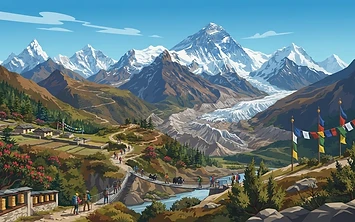
This UNESCO World Heritage site is home to Mount Everest, the world's highest peak, and offers breathtaking Himalayan landscapes. It is a premier destination for trekkers seeking to experience high-altitude glaciers and unique Sherpa culture.
Witness the awe-inspiring majesty of the world's tallest mountain range.

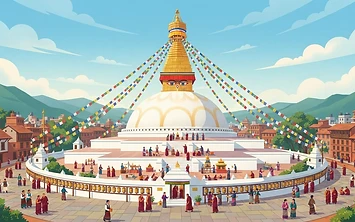
As one of the largest spherical stupas in the world, this site serves as a vital center for Tibetan Buddhist culture in Nepal. Its massive mandala design and the watchful eyes of Buddha make it a profound spiritual landmark.
Experience the serene atmosphere as pilgrims circle the stupa under the glow of butter lamps.

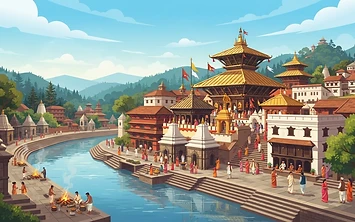
Situated on the banks of the sacred Bagmati River, this is Nepal's most significant Hindu temple complex. It is a centuries-old site of pilgrimage known for its intricate pagoda-style architecture and traditional cremation rituals.
Observe the profound cultural traditions and spiritual life along the riverbanks.

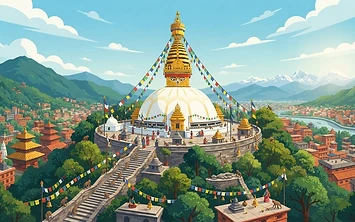
Perched atop a hill overlooking the Kathmandu Valley, this ancient religious site is often called the 'Monkey Temple' due to the resident primate population. It features a iconic white dome topped with a gilded spire painted with the eyes of Buddha.
Enjoy panoramic views of the entire Kathmandu Valley from this historic vantage point.

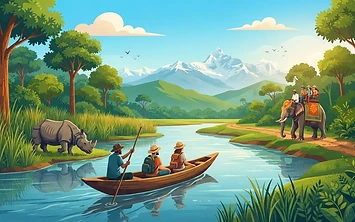
This UNESCO World Heritage site is one of Asia's premier wildlife reserves, protecting diverse species including the one-horned rhinoceros and Bengal tiger. It offers visitors a chance to explore lush subtropical forests through jungle safaris and canoe trips.
Spot rare wildlife in their natural habitat within one of Nepal's most biodiverse regions.

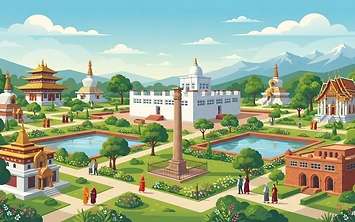
Recognized as the birthplace of Lord Buddha, this sacred pilgrimage site features the Maya Devi Temple and the Ashoka Pillar. It is a peaceful area filled with monasteries and monuments built by various Buddhist nations from around the world.
Visit the exact site where Lord Buddha is believed to have been born.
Geography
Nature
Mount Everest
8,849 m / 29,032 ft
44.6% of land
≈ 65,792 km² of forest
FAO / World Bank, forest area (% of land area)
Explore the Nature Atlas1,080 km671 mi
The longest river in Nepal rising in the Tibetan Plateau near Lake Manasarovar.
630 km391 mi
Famous for the Kali Gandaki Gorge which is one of the deepest river canyons globally.
720 km447 mi
Also known as the Saptakoshi due to the seven major tributaries that form it.
10 km²4 sq mi · 167 m deep
The largest and deepest freshwater lake in the Nepal Himalayas.
4 km²2 sq mi · 24 m deep
Located in Pokhara and features the Tal Barahi Temple on a small island.
5 km²2 sq mi · 200 m deep
One of the highest lakes in the world situated at 4919 metres altitude.
381 m1,250 ft
Known as one of the tallest waterfalls found within the central region of Nepal.
30 m98 ft
A popular tourist attraction in Pokhara where the river vanishes into an underground tunnel.
River lengths are whole-river figures, including any section beyond Nepal. Researched reference figures. Tap any name for where its name comes from and a Google Maps link.
Major Cities
- 1Capital
799,5602026
MapServes as the capital of Nepal and acts as the cultural, historical, and economic center of the country.
- 2
Gaṇḍakī
571,9402026
MapFeatures the scenic Phewa Lake and serves as the primary gateway for trekkers visiting the Annapurna Circuit.
- 3
420,2062026
MapFunctions as a major commercial and healthcare hub for the central region of the Terai plains.
- 4
356,4412026
MapStands as an emerging urban trade center situated along the East-West Highway in the Bara District.
- 5
287,7372026
MapKnown as the Gateway to Nepal, this city handles the majority of the nation's trade imports and exports.
- 6
Province Number One
257,7142026
MapOperates as a vital industrial powerhouse and a major trade gateway for goods entering from India.
- 7
228,9902026
MapActs as a primary commercial and transit hub for the far-western region of Nepal.
- 8
Lumbinī
227,9362026
MapFunctions as a key commercial link connecting the western hill regions with the southern Terai plains.
- 9
225,4652026
MapServes as the administrative headquarters of Dang District and acts as an educational hub for western Nepal.
- 10
Bāgmatī
216,5652026
MapOperates as a significant industrial city that connects the capital Kathmandu with the southern plains.
- 11
Madhesh
212,6592026
MapContains the historic Janaki Mandir and is deeply rooted in the mythology of the Ramayana epic.
- 12
180,7002026
MapRenowned for its pleasant climate and serves as an educational and healthcare center for eastern Nepal.
City populations are the latest official, UN or national-statistics estimates (2026–2026) compounded to 2026 at 0.9% a year (the nation's annual population growth rate); figures without a published update come from the open cities database (2020-era estimates) and are projected the same way.
Economy
Main exports
Nepal's leading export commodities and products.
Tap any export to learn more. Spot prices in USD only for Live Data subscribers.
Main imports
Nepal's leading import commodities and products.
Tap any import to learn more.
Military
Historical Timeline
8000 BCE
Early Human Settlement in the Himalayas
Archaeological evidence suggests that hunter-gatherer communities established the first human settlements in the high-altitude valleys and foothills of the Himalayas. These early inhabitants laid the foundation for the diverse cultural and ethnic development of the region.
500 BCE
Birth of Siddhartha Gautama
Siddhartha Gautama, who later became the Buddha, was born in Lumbini. This event established Nepal as a global center for Buddhist philosophy and spiritual heritage.
464
Establishment of the Licchavi Dynasty
The Licchavi Kingdom emerged as a dominant power in the Kathmandu Valley, marking the beginning of a period often considered the golden age of Nepali art, culture, and governance.
1768
Unification of Nepal
King Prithvi Narayan Shah completed the conquest of the Kathmandu Valley, unifying disparate principalities into a single modern state. This event formally established the Kingdom of Nepal.
1816
Signing of the Treaty of Sugauli
Following the Anglo-Nepalese War, Nepal signed the Treaty of Sugauli with the British East India Company. This agreement resulted in the loss of territory but formally recognized Nepal's status as a sovereign state.
1846
Rise of the Rana Regime
The Kot Massacre enabled Jung Bahadur Rana to seize power, establishing a hereditary prime ministerial system that sidelined the monarchy for over a century. This era was characterized by isolationist policies and consolidated family rule.
1951
End of the Rana Autocracy
A popular revolution supported by the monarchy ended the 104-year Rana regime and restored the King's authority. This transition initiated Nepal's move toward a multi-party democratic political system.
1996
Beginning of the Maoist Insurgency
The Communist Party of Nepal (Maoist) launched an armed struggle against the state to protest social inequality and monarchical rule. The decade-long conflict significantly altered the nation's political and social landscape.
2008
Abolition of the Monarchy
The newly elected Constituent Assembly formally abolished the monarchy and declared Nepal a federal democratic republic. This transition ended over 240 years of monarchical rule.
2015
Promulgation of the New Constitution
Nepal adopted a new constitution, transforming the country into a federal democratic republic with seven provinces. The document aimed to secure civil rights and decentralize administrative power.
2022
Election of Nepal's First Dalit Deputy Speaker
Pushpa Bhusal and subsequent parliamentary developments highlighted efforts toward greater representation for marginalized groups. These political shifts reflected the evolving inclusive goals of the post-2015 constitutional framework.
2025
Continued Implementation of Federal Infrastructure Projects
The government focused on the acceleration of major infrastructure projects and connectivity initiatives in 2025 to boost economic stability. These efforts represent the current national priority of achieving sustainable development and regional trade integration.
National Anthem
Sayaun Thunga Phool Ka
Pradeep Kumar Rai (Byakul Maila)
Amber Gurung
2007
सयौं थुँगा फूलका हामी, एउटै माला नेपाली, सार्वभौम भई फैलिएका, मेची-महाकाली। प्रकृति कायामा झन् बढी, वीरहरूका रगतले, स्वतन्त्र र अटल रहेका, संसारमा नेपाली। सयौं थुँगा फूलका हामी, एउटै माला नेपाली, सार्वभौम भई फैलिएका, मेची-महाकाली। सयौं थुँगा फूलका हामी, एउटै माला नेपाली, सार्वभौम भई फैलिएका, मेची-महाकाली। बहु जाति भाषा धर्म संस्कृति छन् विशाल, अग्रगामी राष्ट्र हाम्रो, जय जय नेपाल।
The current national anthem of Nepal, 'Sayaun Thunga Phool Ka', was selected following the abolition of the monarchy and the transition to a secular republic. A nationwide competition was held in 2006 to replace the old royal anthem, 'Shreeman Gambhir'. Pradeep Kumar Rai, pen-named Byakul Maila, wrote the lyrics, while the music was composed by Amber Gurung. The anthem was officially adopted on August 3, 2007, as a symbol of a new, inclusive, and democratic Nepal. Unlike the previous anthem, which focused on the King, the new lyrics celebrate the country's multi-ethnic diversity, geographical expanse, and sovereignty. It was designed to foster a sense of national unity among all Nepalese citizens regardless of their caste, creed, or language. It remains a powerful cultural emblem of the country's modern political identity.
National Holidays
This day commemorates the end of the Rana autocracy in 1951 and the establishment of democracy in Nepal.
Based on the Bikram Sambat calendar, this day marks the first day of the new year and is celebrated with cultural events and family gatherings.
This day marks the anniversary of the promulgation of the Constitution of Nepal in 2015, which established the country as a federal democratic republic.
The longest and most significant Hindu festival in Nepal, it celebrates the triumph of good over evil with various religious ceremonies.
Also known as the festival of lights, this five-day event honors various animals and deities, symbolizing the connection between humans and nature.
Good News Today
Foundation provides livelihood support to families of fallen mountain workers
The Shangri-La Nepal Foundation and The Juniper Fund have provided financial and livelihood assistance to over 88 families of deceased mountain workers. The initiative includes skills training, entrepreneurship support, and educational aid to help these families achieve long-term stability.
Fun Facts
Home of the World's Roof
Nepal is home to eight of the ten tallest mountains in the world, including Mount Everest, which sits directly on the border with China.
Unique Non-Quadrilateral Flag Design
Nepal possesses the only national flag in the world that is not rectangular or square, featuring two stacked triangles representing the Himalayan peaks.
Living in the Future
Nepal follows its own unique calendar system, the Bikram Sambat, which is approximately 56.7 years ahead of the Gregorian calendar.
Living Goddess Tradition Continues
The Kumari is a young pre-pubescent girl worshipped as a living goddess in Nepal, selected through ancient rigorous tests and honored during festivals.
Rare One-Horned Rhino Sanctuary
Chitwan National Park serves as one of the few remaining refuges for the endangered greater one-horned rhinoceros in the wild.
The Beloved Momo Dumpling Culture
Momo, a steamed dumpling filled with meat or vegetables, is the unofficial national dish and a culinary staple found in every corner of the country.
A Unique Time Zone Offset
Nepal uses a non-standard time zone, UTC+5:45, making it one of the few countries with a 45-minute offset from Coordinated Universal Time.
Extreme High Altitude Marathon
The Tenzing-Hillary Everest Marathon is recognized as the highest altitude marathon in the world, starting at Everest Base Camp at 5,364 meters.
Terrifying Honey Hunting Tradition
The Gurung people of central Nepal practice ancient honey hunting, scaling massive cliffs using homemade rope ladders to harvest hallucinogenic honey from wild bees.
Birthplace of Lord Buddha
Lumbini, located in the southern plains, is the sacred pilgrimage site recognized globally as the birthplace of Siddhartha Gautama, who became the Buddha.
Chuckies Trivia Quiz
Chuckies Trivia Quiz
Fifteen questions on Nepal — five easy, five medium, five hard. How far can you get?
Sports & Live Events
Language
Counting to 10
1
1
= 10 (n = 0)
World Dictionary
Discover and translate any word into all supported languages.