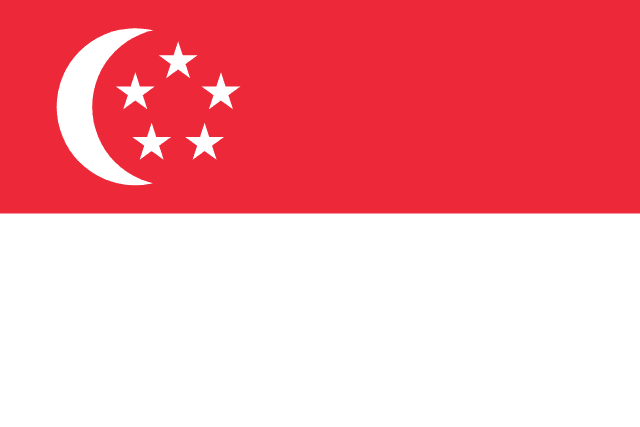

Singapore
Republic of Singapore
Asia
6,174,278
17:07 UTC+8
+65
.sg
Bukit Timah
163 m · 535 ft
Singapore Strait
0 m · 0 ft
5,938,569
Singapore · 2026
5,938,569
Singapore · 2026
Location
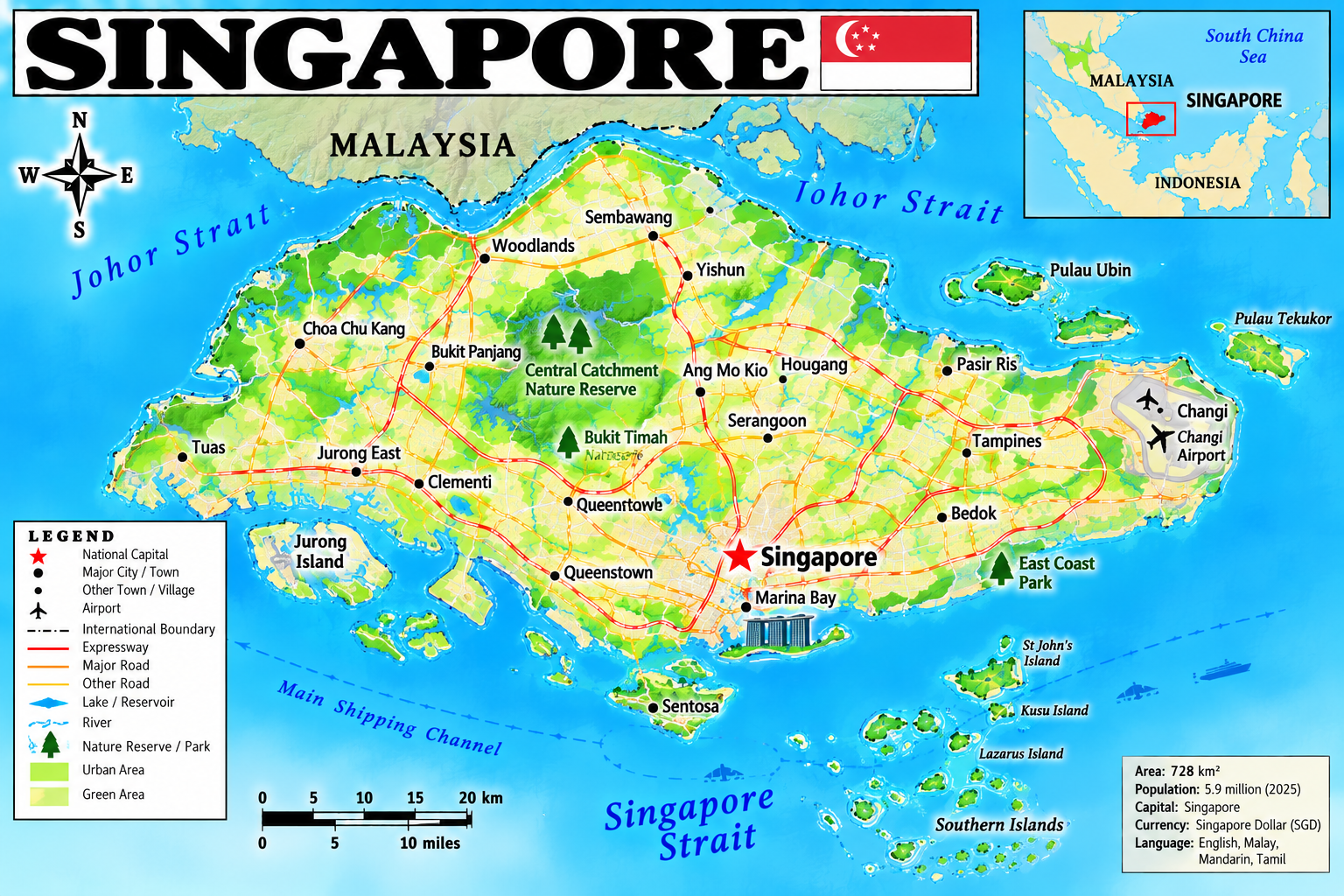
Singapore — Detailed Physical Map
The main island and its offshore islands, Bukit Timah and the Central Catchment reserve, Changi Airport, Sentosa, expressways and the capital Singapore
Tourist Attractions

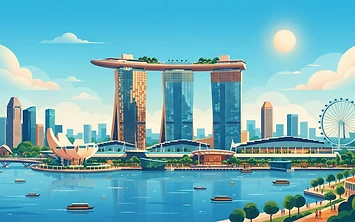
This iconic integrated resort is defined by its three soaring towers topped by the gravity-defying Sands SkyPark. It serves as a premier destination for luxury shopping, dining, and panoramic city views.
The SkyPark Observation Deck offers an unparalleled vantage point of the Singapore skyline.

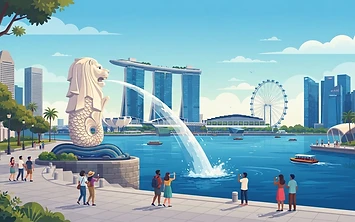
Home to the famous Merlion statue, a mythical creature with a lion's head and a fish's body, this park is a symbol of Singapore's origins as a fishing village. It provides a scenic waterfront view of the bay area.
It is the quintessential spot for a classic photo with the city's most famous mascot.

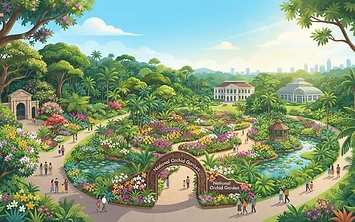
As Singapore's first UNESCO World Heritage Site, this lush tropical garden spans over 82 hectares. It features a diverse collection of flora, including the world-renowned National Orchid Garden.
It is a peaceful, verdant escape that showcases the city's commitment to being a 'City in a Garden'.

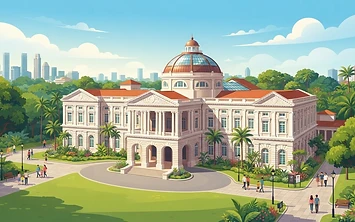
Dating back to 1887, this is the nation's oldest museum and is housed in a stunning neo-classical building. It offers immersive exhibitions that detail the history and cultural evolution of Singapore.
The museum houses the Singapore Stone, one of the nation's most significant historical artifacts.

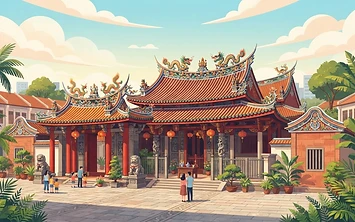
Built in 1821, this is the oldest and most famous Hokkien temple in Singapore. It is a masterpiece of traditional Chinese architecture, constructed without the use of a single nail.
The intricate carvings and traditional craftsmanship offer a deep look into the heritage of early Chinese immigrants.

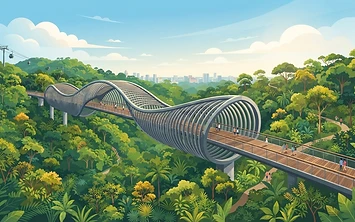
This architectural marvel is the highest pedestrian bridge in Singapore, known for its distinctive wave-like structure made of curved steel ribs. It connects Mount Faber Park to Telok Blangah Hill Park.
The bridge provides a unique, elevated walking experience surrounded by the lush canopy of the Southern Ridges.
Geography
Nature
Bukit Timah
163 m / 535 ft
21.0% of land
≈ 153 km² of forest
FAO / World Bank, forest area (% of land area)
Explore the Nature Atlas3 km2 mi
Flows through the central business district into the Marina Reservoir.
10 km6 mi
Longest river in Singapore running from the Lower Peirce Reservoir.
5 km3 mi
Located within a protected nature reserve and wetlands area.
1 km²0 sq mi
Oldest reservoir in Singapore completed in 1868.
1 km²0 sq mi
Second oldest reservoir situated within the Central Catchment Nature Reserve.
1 km²0 sq mi · 18 m deep
Former sand quarry transformed into a large recreational water body.
40 m131 ft
Tallest indoor waterfall in the world located inside Jewel Changi Airport.
30 m98 ft
Man-made waterfall situated within the Jurong Bird Park.
River lengths are whole-river figures, including any section beyond Singapore. Researched reference figures. Tap any name for where its name comes from and a Google Maps link.
Major Cities
- 1Capital
6,210,0002026
MapServes as a global financial hub and major maritime gateway located at the southern tip of the Malay Peninsula.
City populations are the latest official, UN or national-statistics estimates (2026–2026) compounded to 2026 at 0.75% a year (the nation's annual population growth rate); figures without a published update come from the open cities database (2020-era estimates) and are projected the same way.
Economy
Main exports
Singapore's leading export commodities and products.
Tap any export to learn more. Spot prices in USD only for Live Data subscribers.
Main imports
Singapore's leading import commodities and products.
Tap any import to learn more.
Military
Historical Timeline
2000 BCE
Early Austronesian Settlement
Austronesian settlers arrived on the island, establishing early maritime communities. Archaeological findings indicate these groups engaged in trade and fishing within the region.
1299
Founding of Singapura
Sang Nila Utama is traditionally credited with founding the Kingdom of Singapura, also known as Temasek. The settlement served as a strategic trading post between the Indian Ocean and the South China Sea.
1819
Establishment of British Trading Post
Sir Stamford Raffles landed in Singapore and signed a treaty with local rulers to establish a British East India Company trading post. This marked the beginning of modern Singapore as a colonial port.
1824
Treaty of London
The Anglo-Dutch Treaty formally ceded Singapore to the British, solidifying their control over the island. This led to Singapore becoming part of the Straits Settlements in 1826.
1942
Fall of Singapore to Japan
British forces surrendered to the Imperial Japanese Army during World War II, resulting in the Japanese occupation of Singapore until 1945. This period caused immense hardship and shifted the political trajectory toward independence.
1959
Self-Government Achieved
Singapore attained full internal self-government from the British, with the People's Action Party winning the first general election. Lee Kuan Yew became the first Prime Minister.
1963
Merger with Malaya
Singapore joined the Federation of Malaysia to gain full independence from British rule. The merger was marked by political and social tensions that eventually led to separation.
1965
Independence as a Sovereign Nation
Singapore was expelled from Malaysia and became an independent sovereign republic on August 9. The new government faced significant economic and security challenges as a small, resource-poor nation.
1971
Launch of the Economic Development Board
The government intensified efforts to attract foreign direct investment and pivot toward manufacturing and export-oriented industrialization. This strategy transformed Singapore into a major global economic hub.
1990
Leadership Transition to Goh Chok Tong
Lee Kuan Yew stepped down as Prime Minister after 31 years, marking the first major leadership transition in independent Singapore. This ensured the continuity of the nation's governance model.
2004
Lee Hsien Loong Becomes Prime Minister
Lee Hsien Loong took office as the third Prime Minister of Singapore, steering the country through significant economic restructuring and social policy shifts. He held the position for two decades.
2024
Lawrence Wong Appointed Prime Minister
Lawrence Wong was sworn in as the fourth Prime Minister of Singapore, succeeding Lee Hsien Loong. This marked the official transition of leadership to the nation's fourth-generation political team.
2025
Launch of Singapore Odyssea exhibition
The Singapore Odyssea: A Journey Through Time exhibition was launched at the National Museum's revamped Shaw Foundation Glass Rotunda in August 2025 as a gift to the nation for SG60.
2026
Reopening of the Singapore History Gallery
The Singapore History Gallery reopened on 10 October 2026 following its first full revamp since its original launch in 2006.
2026
National Day Parade held at National Stadium
The 2026 National Day Parade was held at the National Stadium on 9 August 2026, marking the first time the event was hosted there in a decade.
National Anthem
Zubir Said
Zubir Said
1959
Mari kita rakyat Singapura Sama-sama menuju bahagia Cita-cita kita yang mulia Berjaya Singapura Marilah kita bersatu Dengan semangat yang baru Semua kita berseru Majulah Singapura Marilah kita bersatu Dengan semangat yang baru Semua kita berseru Majulah Singapura
The anthem was composed by Zubir Said in 1958 at the request of the Singapore City Council. It was officially adopted in 1959 upon Singapore's attainment of self-government from Britain. The title 'Majulah Singapura' means 'Onward Singapore' in Malay, which is the national language of the country. The anthem replaced the British anthem 'God Save the Queen' that was previously used. Following Singapore's independence in 1965, the anthem was formally retained as the national anthem. Although Singapore has four official languages, the anthem is performed exclusively in its original Malay lyrics. It serves as a symbol of unity and aspiration for the nation's multi-racial society.
National Holidays
This holiday marks the beginning of the new calendar year.
This festival marks the beginning of the lunar new year and is a major cultural celebration for the Chinese community in Singapore.
This day is dedicated to celebrating the contributions and achievements of workers across the nation.
This date commemorates Singapore's independence and separation from Malaysia in 1965.
Known as the Festival of Lights, it is a significant celebration for the Hindu community signifying the victory of light over darkness.
This holiday celebrates the birth of Jesus Christ and is widely observed as a public holiday in Singapore.
Good News Today
Singapore launches green cooperation programme to help developing countries
Singapore has introduced the Singapore Green Cooperation Programme to provide technical assistance, climate finance, and advisory services to developing nations. The initiative includes a $500,000 donation to help Pacific island countries strengthen their resilience against climate change and natural disasters.
Fun Facts
The Lion City Origin Name
The name Singapore comes from the Sanskrit words 'Singa' meaning lion and 'Pura' meaning city. Despite the name, lions are not native to the island; the founder likely saw a tiger and mistook it for a lion.
A True City In Nature
Singapore is known as a City in Nature, with nearly 50 percent of its land area covered by greenery. It hosts the only tropical botanic garden on the UNESCO World Heritage List.
The Chewing Gum Ban Legend
The sale and import of chewing gum have been restricted in Singapore since 1992 to keep public spaces clean. You can only purchase sugar-free gum from a pharmacy with a medical prescription.
World Record For Vertical Gardens
The Oasia Hotel Downtown is a marvel of urban architecture, covered in 21 different species of creeping plants. It functions as a vertical garden that helps cool the building naturally.
Hawker Culture Is World Heritage
Singaporean hawker culture, where diverse communities gather to eat at affordable stalls, was recognized by UNESCO as Intangible Cultural Heritage. It is the only place in the world where a Michelin-starred meal can cost just a few dollars.
First Night Grand Prix Race
The Singapore Grand Prix was the first-ever night race in Formula One history. The Marina Bay Street Circuit is illuminated by high-powered floodlights that create a near-daylight effect on the track.
Diverse Religious Harmony Architecture
The Telok Ayer Street is famous for having a mosque, a Methodist church, and a Chinese temple all located within a short walking distance of each other. This reflects the country's deep commitment to multi-religious harmony.
The World's Most Expensive City
Singapore has frequently been ranked as the most expensive city in the world to live in. This is largely due to the high costs of owning a car and housing in such a land-scarce nation.
Airport With A Giant Waterfall
Changi Airport features the Jewel, which houses the world's tallest indoor waterfall known as the Rain Vortex. It is fed by collected rainwater and surrounded by a terraced forest landscape.
Passport Power In The World
Singapore consistently ranks among the top passports globally, allowing citizens to travel to more than 190 countries visa-free. It is highly valued for the international mobility it provides.
Chuckies Trivia Quiz
Chuckies Trivia Quiz
Fifteen questions on Singapore — five easy, five medium, five hard. How far can you get?
Sports & Live Events
Language
Counting to 10
1
1
= 10 (n = 0)
World Dictionary
Discover and translate any word into all supported languages.