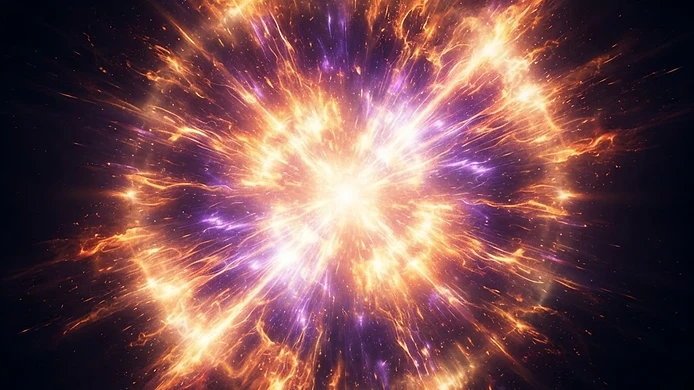
Space, time, matter and energy erupt from an infinitely hot, dense point. Hydrogen and helium — the raw fuel of every star — form within minutes.
In the first three minutes the universe cools from a trillion degrees to a billion — hot enough to fuse, cold enough for the simplest nuclei to survive. For 380,000 years it is a glowing fog, until the first atoms form and light travels freely for the first time. That ancient glow still fills the sky today as the cosmic microwave background.
- Everything in the universe was once compressed into a space smaller than an atom
- The whole hydrogen-helium recipe for the first stars was cooked in 3 minutes
- The afterglow (cosmic microwave background) is still detectable everywhere — it is the oldest light we can see
The whole story
13.8 billion years ago
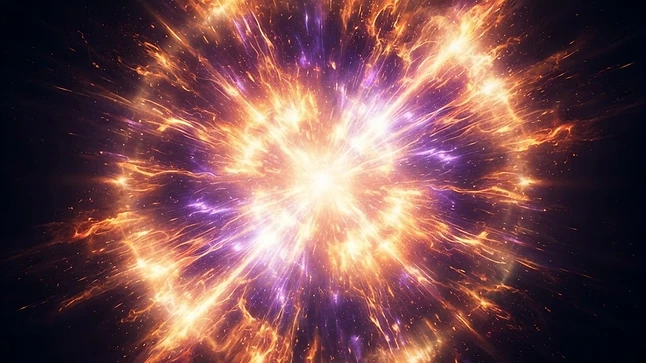
Space, time, matter and energy erupt from an infinitely hot, dense point. Hydrogen and helium — the raw fuel of every star — form within minutes.
In the first three minutes the universe cools from a trillion degrees to a billion — hot enough to fuse, cold enough for the simplest nuclei to survive. For 380,000 years it is a glowing fog, until the first atoms form and light travels freely for the first time. That ancient glow still fills the sky today as the cosmic microwave background.
- Everything in the universe was once compressed into a space smaller than an atom
- The whole hydrogen-helium recipe for the first stars was cooked in 3 minutes
- The afterglow (cosmic microwave background) is still detectable everywhere — it is the oldest light we can see
~13.5 billion years ago
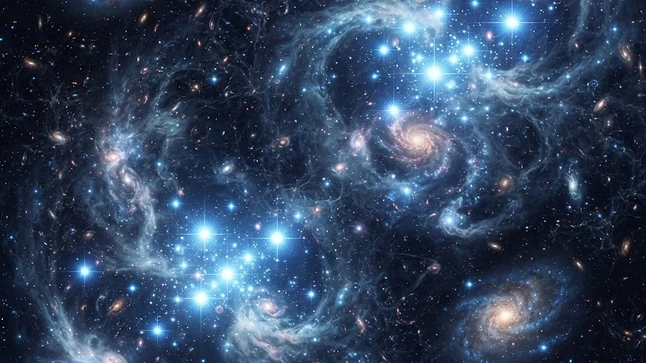
Gravity gathers gas into the first stars and galaxies. In their furnaces, heavier elements — carbon, oxygen, iron — are forged for the first time.
The first stars were giants — dozens to hundreds of times the mass of the Sun — burning fast and dying young in blinding supernovae. Their deaths scattered the first carbon, oxygen and iron into space. Without those star-forged elements there would be no planets, no oceans, and no biology to think about them.
- First stars were 10-100x the Sun's mass and lived only a few million years
- Every carbon atom in your body was forged inside a star
- Our Milky Way contains about 100-400 billion stars today
~4.54 billion years ago
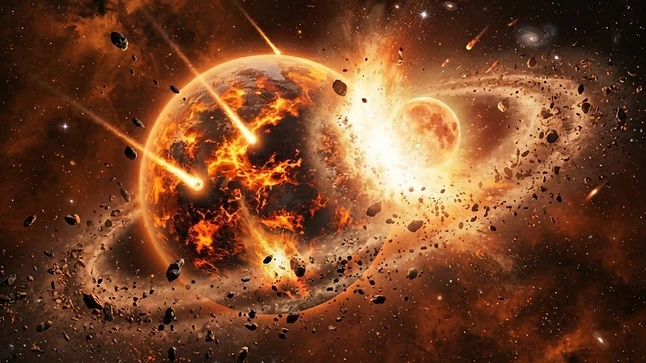
Our planet accretes from the dust of the young Sun. A giant impact carves off the Moon, and a molten world slowly cools into oceans under a hostile sky.
Young Earth is struck by a Mars-sized body — the debris rings out into the Moon, and the collision resets the planet's clock. For millions of years asteroids bombard the surface, yet rain falls on cooling rock, and steam condenses into the first oceans. By 4 billion years ago, conditions beneath those oceans are stable enough for chemistry to get organised.
- The Moon-forming impact likely melted the entire planet
- Oceans may have formed within 200 million years of Earth's birth
- Earth sits in the Sun's habitable zone, where water stays liquid
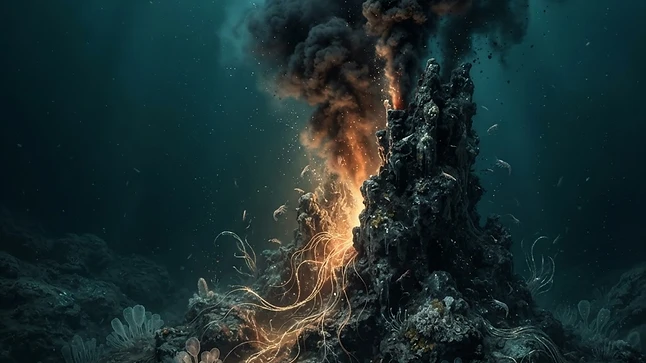
~3.7-4.0 billion years ago
In the deep oceans, chemistry crosses the line into biology: self-replicating molecules, the last universal common ancestor, and the first single cells.
Where and how remains one of science's great open questions — candidates include hydrothermal vents on the seafloor, warm shallow pools, and mineral foams on early shores. What is certain: by 3.5 billion years ago microbial communities leave fossil mounds called stromatolites, and every living thing on Earth descends from a single ancestor — 'LUCA' — a simple cell that already used DNA, RNA and proteins.
- LUCA, our last universal common ancestor, lived about 3.8 billion years ago
- All known life shares the same genetic code — evidence of one origin
- Earliest accepted fossils: 3.5-billion-year-old stromatolites in Western Australia
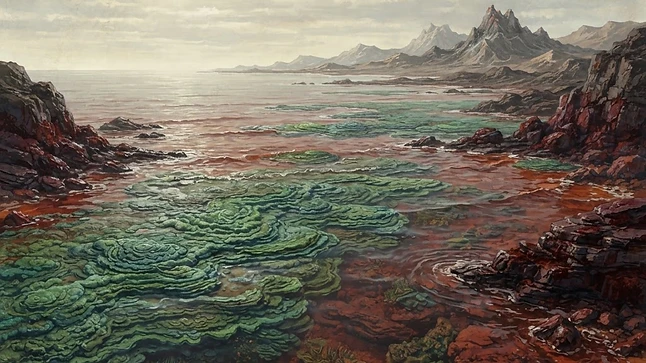
~2.4 billion years ago
Cyanobacteria flood the air with oxygen — a catastrophe for early life, but the foundation for every breath since. Complex cells begin to evolve.
For over a billion years life stays microbial while sunlight, carbon dioxide and water are quietly turned into sugar and waste oxygen. When ocean sinks fill, oxygen finally leaks into the air — rusting the oceans, killing much of the anaerobic world, and triggering 'Snowball Earth' glaciations. Around the same time, a cell swallows a bacterium and keeps it: mitochondria are born, and complex life becomes possible.
- Oxygen was poison — the first mass extinction was caused by life itself
- Rusted seafloor stripes in ancient rock record the oxygen's slow rise
- Mitochondria in your cells are the descendants of one captured bacterium
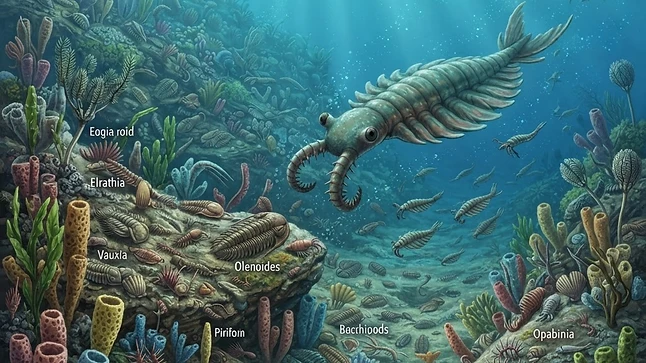
~540 million years ago
In a geological blink, almost every animal body plan appears: eyes, shells, predators and prey. The seas fill with the ancestors of all animals alive today.
Rising oxygen and the evolution of vision may have lit the fuse. Within roughly 20-25 million years — a blink in deep time — nearly every major animal group appears in the fossil record: arthropods with compound eyes, spiny predators like Anomalocaris, soft-bodied wonders preserved at sites such as Chengjiang and the Burgess Shale. The arms race between hunter and hunted had begun.
- First compound eyes evolved here — vision changed evolution itself
- Anomalocaris, a metre-long swimming predator, ruled the Cambrian seas
- Almost every animal phylum alive today traces to this window

230-66 million years ago
Dinosaurs rule for 165 million years while flowers, birds and mammals emerge in their shadow. An asteroid ends their reign in a single terrible day.
Dinosaurs dominate every continent as supercontinents split apart, conifers spread and then true flowers bloom. Some grow to 40-metre lengths; others take to the air as birds — which are, technically, living dinosaurs. Then, 66 million years ago, a 10-kilometre asteroid hits the Yucatán: darkness, collapsing food chains, and the extinction of three-quarters of all species.
- Argentinosaurus may have weighed up to 70-100 tonnes — the heaviest land animal ever
- Birds are the dinosaurs' direct descendants — and they survived
- The impact crater at Chicxulub, Mexico, is about 180 km wide
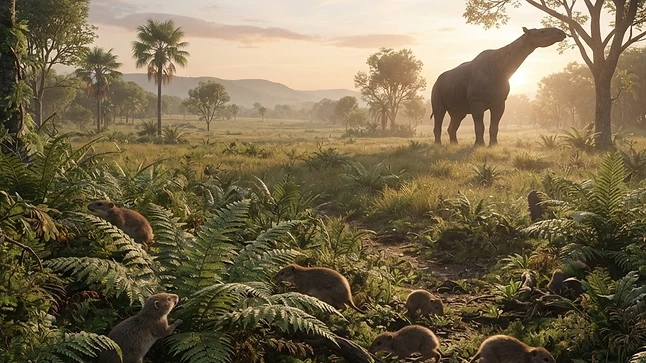
66-2.6 million years ago
Mammals inherit the Earth — whales return to the sea, grasslands spread, and in Africa a lineage of apes begins walking upright.
Small, nocturnal survivors radiate into whales, bats, elephants, and grass-eating giants as grasslands replace forests. Around 55 million years ago whale ancestors wade back into the sea; by 7 million years ago in Africa, an ape lineage splits from chimpanzees and starts walking on two legs — setting the stage for us.
- Whales evolved from hoofed land mammals — their closest relative is the hippo
- Mammals were already 200 million years old when they took over — they had waited in the shadows
- Human and chimpanzee lineages split roughly 6-7 million years ago
~300,000 years ago
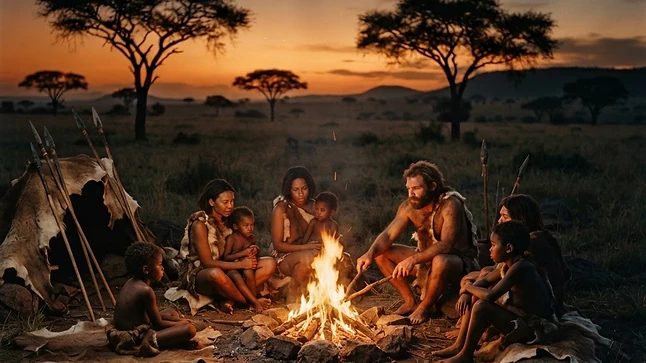
Homo sapiens evolves, spreads across every continent, farms, builds cities and civilizations — and learns to read the deep story of its own past.
Our species appears in Africa, shares the planet for a while with Neanderthals and other cousins, then spreads across the globe. Around 10,000 years ago farming begins, populations swell, writing follows, and in a few hundred generations we go from scattered villages to a networked civilisation of eight billion — one that can now sequence its own genome and photograph the universe's first galaxies.
- The oldest known Homo sapiens fossils (Jebel Irhoud, Morocco) are about 300,000 years old
- Neanderthals and modern humans interbred — most people today carry a little of their DNA
- Farming began independently in at least seven regions of the world
Today
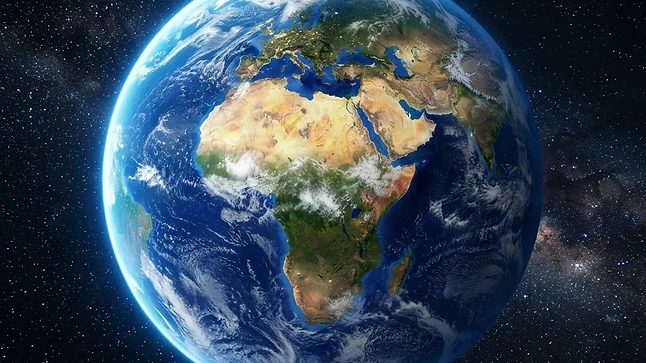
An estimated 8.7 million species share one living planet. Life has been continuous here for nearly 4 billion years — and the next chapter is being written now.
A living world of forests, reefs, soils and seas cycles water, carbon and nitrogen on a planetary scale. But this chapter carries a warning: species are now disappearing up to hundreds of times faster than the natural background rate, the climate is warming, and the changes are ours. Life is resilient — it has survived five great extinctions — but the world our grandchildren inherit depends on this decade.
- Microbes still outnumber all other life — by mass, plants are ~80% of Earth's biomass
- About 1.5 million species have been described; millions more await discovery
- Life on Earth has run unbroken for nearly 4 billion years


