Adherents
All early humans
Sacred texts
Oral tradition
Origin
Worldwide
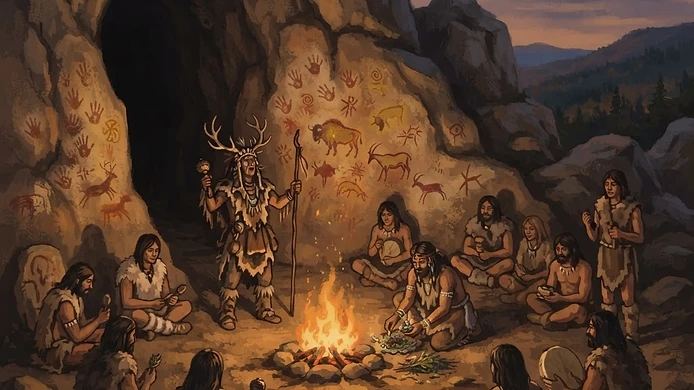
The roots of religion reach back to deliberate burial, cave art and ritual objects — evidence that early humans believed in something beyond the visible world.
Neanderthal and early human burial sites, ochre-painted skulls and 40,000-year-old cave paintings suggest symbolic thought and ideas about death and spirits long before writing. Shamans, ancestor reverence and animism — the sense that animals, rivers and storms hold spirit — formed the foundation every later faith built upon.
- The oldest known burial rituals date back roughly 100,000 years
- Cave art such as Lascaux (c. 17,000 BCE) is often read as ritual or shamanic
- Animism — spirit in nature — is the belief pattern found on every inhabited continent
The whole timeline
c. 100,000-10,000 BCE · Worldwide
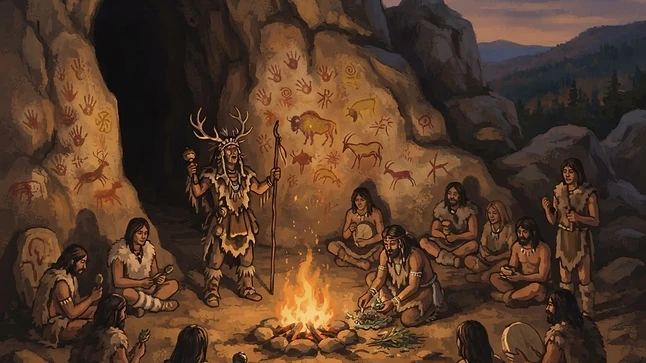
The roots of religion reach back to deliberate burial, cave art and ritual objects — evidence that early humans believed in something beyond the visible world.
Neanderthal and early human burial sites, ochre-painted skulls and 40,000-year-old cave paintings suggest symbolic thought and ideas about death and spirits long before writing. Shamans, ancestor reverence and animism — the sense that animals, rivers and storms hold spirit — formed the foundation every later faith built upon.
- The oldest known burial rituals date back roughly 100,000 years
- Cave art such as Lascaux (c. 17,000 BCE) is often read as ritual or shamanic
- Animism — spirit in nature — is the belief pattern found on every inhabited continent
c. 3500-3100 BCE · Tigris-Euphrates & Nile valleys
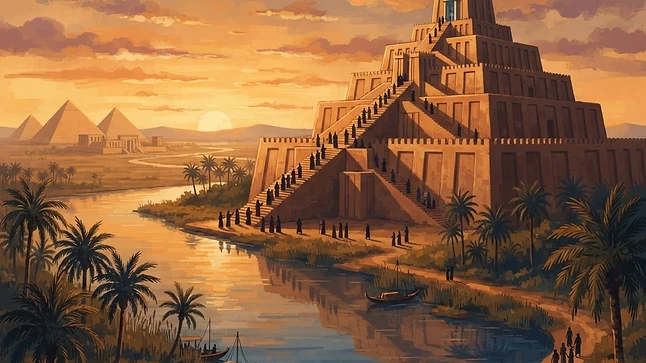
The first organised state religions arise in Sumer and Egypt: temple priesthoods, ziggurats and pyramids, and written myths about gods, floods and the afterlife.
Sumerian city-states worshipped patron gods through temple priesthoods, and their Epic of Gilgamesh carries a flood story strikingly like later ones. Egypt built its entire civilisation around the afterlife — Pyramid Texts and the Book of the Dead guided pharaohs to eternal life, a belief that shaped the monuments still standing today.
- The Epic of Gilgamesh's flood story predates the biblical Noah by over 1,000 years
- Egyptian Pyramid Texts (c. 2400 BCE) are among the oldest religious writings known
- Temple priesthoods here invented the model of organised religion: rituals, calendars and clergy
c. 2000-1500 BCE · Indus Valley & Vedic India
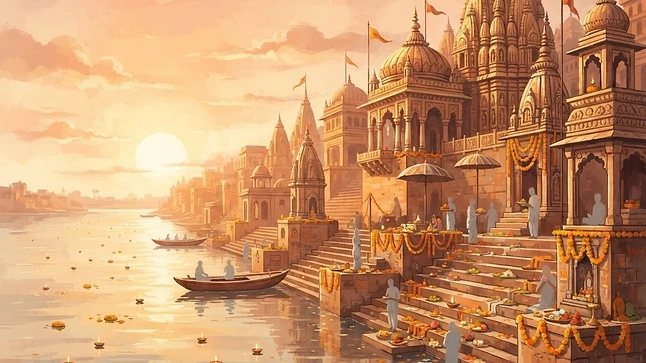
The world's oldest living religion takes shape as Vedic hymns and Indus Valley traditions blend into the vast family of gods, philosophy and practice we now call Hinduism.
The Rig Veda — composed c. 1500-1200 BCE — is among the oldest scripture still in use. Over centuries the Upanishads turned ritual into philosophy: karma, dharma, samsara (rebirth) and moksha (liberation). Hinduism has no single founder, no single text and no single authority — it is a mosaic of traditions from village deities to Vedanta philosophy.
- The Rig Veda is one of the oldest religious texts still in active use
- Hinduism has no founder — it evolved over 3,000+ years of texts and practice
- The Bhagavad Gita, a 700-verse dialogue, is its best-known scripture worldwide
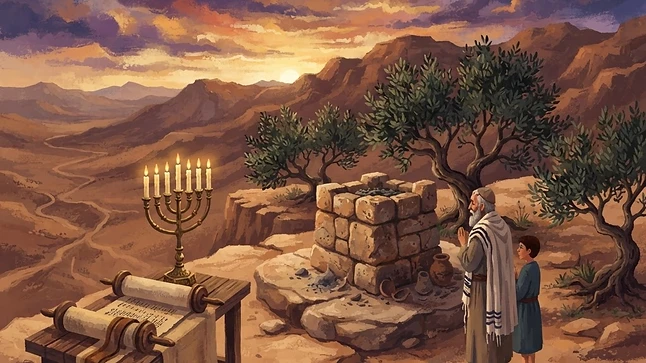
c. 2000-1300 BCE · Canaan & Egypt (traditionally)
Judaism introduces a radical idea: one universal God bound to a people by covenant — the root of the world's monotheistic faiths.
Tradition traces its origins to Abraham's covenant and Moses receiving the Torah at Sinai around 1300 BCE. Exile, temple destruction and diaspora shaped a faith centred on law, study and community rather than temple sacrifice. Christianity and Islam both emerge from this Abrahamic stream.
- The concept of ethical monotheism — one God demanding justice — is Judaism's core legacy
- The Ten Commandments (c. 1300 BCE in tradition) shaped legal systems across the world
- The Western Wall in Jerusalem is the last remnant of the Second Temple, destroyed in 70 CE
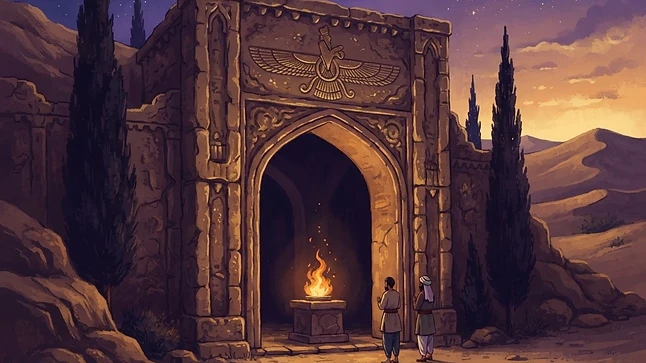
c. 1500-1200 BCE · Ancient Persia
Prophet Zarathustra teaches a cosmic battle between good and evil, judgement after death and a final renewal of the world — ideas that echo through later faiths.
One of the oldest organised religions, Zoroastrianism centres on Ahura Mazda and the free choice between asha (truth) and druj (lie). Its ideas of heaven, hell, final judgement and a saviour appear in Judaism's later books and possibly influenced Christianity and Islam. Fire temples and the tower of silence funerary rites survive in small communities today.
- Scholars see Zoroastrianism's influence in Jewish, Christian and Islamic afterlife ideas
- Its threefold motto: good thoughts, good words, good deeds
- Once the state religion of three Persian empires for over 1,000 years

c. 599 BCE (Mahavira) · Northern India
Mahavira teaches radical non-violence: every living thing has a soul, and liberation comes through ahimsa — harm to none.
An ancient Indian ascetic tradition organised by the 24th Tirthankara, Mahavira, a contemporary of the Buddha. Jains take non-violence to its logical extreme — vegetarianism, filtered water, and monks who sweep the path ahead of each step. Its influence runs deep in Indian ethics and inspired reformers from Gandhi onward.
- Jain monks wear cloth over their mouths to avoid harming even airborne life
- Gandhi credited Jain thought, especially ahimsa, as a key influence
- Jainism rejects a creator god — the universe is eternal and uncreated

c. 563-483 BCE · Northern India & Nepal
Siddhartha Gautama awakens under the Bodhi tree and teaches a middle path: suffering can end through wisdom, ethics and meditation.
The Buddha's Four Noble Truths diagnose suffering and prescribe its end through the Eightfold Path. Buddhism spread across Asia in two great streams — Theravada in Southeast Asia, Mahayana (and later Vajrayana) through China, Korea, Japan and Tibet — adapting to local cultures while keeping meditation and compassion at its core.
- Buddhism is the only world religion that grew from a historical teacher's psychology of suffering
- Emperor Ashoka's 3rd-century-BCE edicts helped carry Buddhism across Asia
- Buddhism's four noble truths and eightfold path prefigure modern mindfulness and CBT

c. 551-300 BCE · China
Confucius and Laozi shape East Asian civilisation: one teaching social harmony through ethics and family, the other harmony with the natural way of things.
Confucianism is less a religion than a civil philosophy — respect, education, filial piety and the rectification of names — that structured Chinese statecraft for 2,000 years. Taoism, attributed to the older Laozi, seeks alignment with the Dao through simplicity and wu wei (effortless action). The two, alongside Buddhism, became East Asia's 'three teachings'.
- Confucian exam systems shaped China's government for roughly 1,300 years
- The Dao De Jing is the most translated book after the Bible
- Most Chinese practice blends all three teachings without seeing conflict

c. 700 BCE onward (formalised) · Japan
Japan's indigenous way honours kami — spirits in mountains, rivers, trees and ancestors — with shrine rituals marking purity, seasons and life's milestones.
Shinto has no founder, no fixed scripture of doctrine and no problem of salvation: it is a practice of ritual purity, gratitude and celebration woven into Japanese life. It coexists comfortably with Buddhism — most Japanese pass through both, shrine and temple, across a lifetime.
- Over 80,000 Shinto shrines operate in Japan today
- Shinto's torii gates mark the threshold between ordinary and sacred ground
- Newborns, weddings and festivals are Shinto; funerals in Japan are typically Buddhist
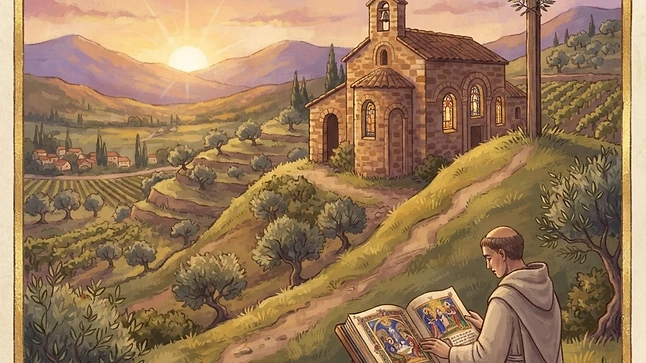
c. 30 CE · Roman Judea
Jesus of Nazareth's teachings of love, forgiveness and the Kingdom of God, and his followers' belief in his resurrection, spark the world's largest religion.
From a handful of disciples, Christianity spread through the Roman world within three centuries — helped by Paul's missions, roads, and a message open to all. Roman adoption in the 4th century made it an empire's faith; schisms later divided it into Catholic, Orthodox and thousands of Protestant traditions. Its calendar, ethics and institutions shaped world history profoundly.
- By 380 CE Christianity went from persecuted sect to the Roman Empire's official religion
- The Great Schism of 1054 split Christianity into East and West
- Christmas and Easter align with, and replaced, older winter and spring festivals

610-632 CE · Mecca & Medina, Arabia
The Prophet Muhammad receives the Quran's revelations over 23 years, establishing a faith of five pillars that becomes the world's second-largest religion.
Islam's five pillars — testimony, prayer, alms, fasting and pilgrimage — structure daily life for nearly two billion people. Within a century of Muhammad's death, Islamic civilisation stretched from Spain to Central Asia, preserving Greek learning and driving advances in mathematics, medicine, astronomy and philosophy during Europe's medieval era.
- The Quran has remained in its original Arabic since the 7th century
- Hajj draws around 2-3 million pilgrims to Mecca each year
- Islamic scholars preserved and extended Greek science, giving us algebra and Arabic numerals

c. 1500 CE · Punjab, India
Guru Nanak teaches one God, equality of all people, and honest labour — a faith born in a borderland of Hindu and Muslim worlds.
Sikhism grew through ten gurus, ending with the scripture itself as the eternal teacher. Its gurdwaras serve free community meals to anyone regardless of caste, creed or wealth — one of the world's largest continuous acts of volunteer hospitality. The Khalsa identity, with uncut hair and turbans, emerged in 1699.
- Langar — the free kitchen in every gurdwara — feeds millions daily worldwide
- Sikhism is the world's fifth-largest religion
- Its scripture is written in Gurmukhi and includes hymns by Hindu and Muslim saints
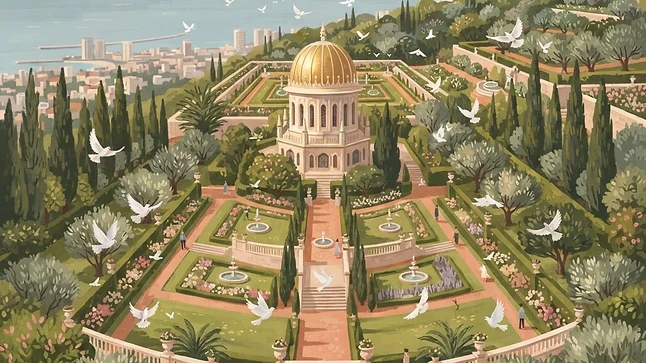
1863 CE · Persia (Iran)
Baháʼu'lláh proclaims the unity of all religions and humanity — one of the youngest independent world religions.
Emerging from 19th-century Persia, the Baháʼí Faith teaches that all major religions come from one God in progressive revelation, and stresses universal education, equality of women and men, and world peace. Its terraced gardens in Haifa, Israel, are a UNESCO World Heritage site.
- The Baháʼí House of Worship template includes nine sides, open to all faiths
- It is one of the most geographically dispersed religions relative to its size
- Baháʼí communities run education programmes in over 180 countries
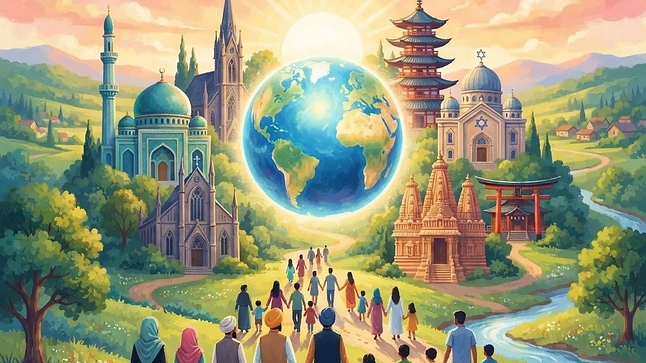
Today · Worldwide
Around 84% of humanity identifies with a religion, yet secularism grows fast — and interfaith dialogue has become a matter of survival, not choice.
Christianity and Islam are still growing, driven by demographics in Africa and Asia; Hinduism and Buddhism hold steady; secular and 'unaffiliated' populations are the fastest-growing group in the West. Religion remains the world's great motivator of both conflict and charity — faith-based aid moves billions in relief every year.
- Roughly 84% of the world identifies with a religious tradition
- The 'nones' — religiously unaffiliated — are the third-largest group globally, after Christians and Muslims
- Nearly every faith shares some form of the Golden Rule across its scriptures


