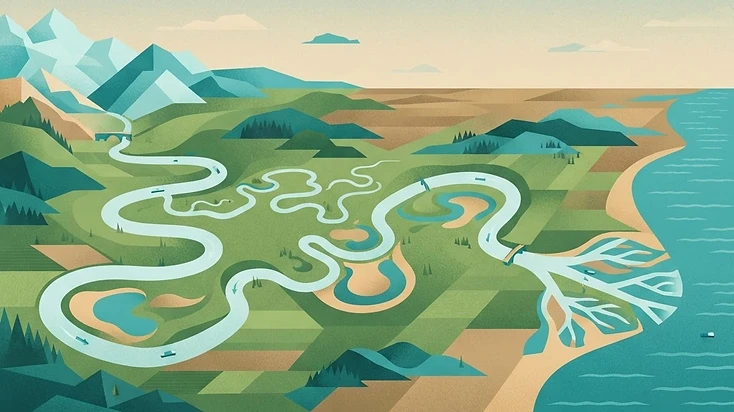
Rivers carry the rain that falls inland back to the ocean, and along the way they cut valleys, build deltas, irrigate crops and feed billions of people. Only about 2.5% of Earth's water is fresh, and most of that is locked in ice — rivers are the tiny, fast-moving share we live on.
Play the Rivers quiz6,650 km
≈ 4,132 mi
Nile length
209,000 m³/s
≈ 7,380,765 ft³/s
Amazon flow
263
Shared basins
~2.5%
Of water is fresh
The longest rivers
Measured from source to mouth; the Amazon–Nile ranking has been argued for decades.
Nile
Burundi to the Mediterranean through 11 countries; the longest river on record.
6,650 km
≈ 4,132 mi
Amazon
Carries more water than the next seven rivers combined — roughly a fifth of all river flow on Earth.
6,400 km
≈ 3,977 mi
Yangtze
The longest river inside one country; its basin holds a third of China's population.
6,300 km
≈ 3,915 mi
Mississippi–Missouri
Drains 41% of the contiguous United States into the Gulf of Mexico.
6,275 km
≈ 3,899 mi
Yenisei
Siberia to the Arctic Ocean, frozen for much of the year.
5,539 km
≈ 3,442 mi
Yellow (Huang He)
Carries more sediment than almost any river on Earth — the 'cradle' of Chinese civilisation.
5,464 km
≈ 3,395 mi
Congo
The deepest river in the world, over 220 m (721.8 ft) down in places, draining the second-largest rainforest.
4,700 km
≈ 2,920 mi
The greatest by volume
Discharge at the mouth — total flow matters more than length for the landscape.
Amazon
Its fresh water is detectable in the Atlantic hundreds of kilometres offshore.
209,000 m³/s
≈ 7,380,765 ft³/s
Congo
Second largest tropical river system and a huge carbon store in its peat swamps.
41,000 m³/s
≈ 1,447,901 ft³/s
Ganges–Brahmaputra
Builds the world's largest delta and waters more than 100 million people.
38,000 m³/s
≈ 1,341,957 ft³/s
Orinoco
Reaches the sea through the vast wetlands of the Llanos and the Warao delta.
36,000 m³/s
≈ 1,271,328 ft³/s
Yangtze
Feeds the Three Gorges Dam, the largest power station on Earth by capacity.
30,000 m³/s
≈ 1,059,440 ft³/s
How rivers shape the land
A river is a moving system, shifting its own course over centuries.
Deltas
Where a river slows at the sea it drops its load — the Nile, Ganges and Mekong deltas each hold millions of people.
Gorges
Uplift forces a river to cut downward; the Grand Canyon exposes nearly two billion years of rock.
Meanders and oxbows
Rivers loop across floodplains until a bend is cut off, leaving a crescent-shaped oxbow lake.
Endorheic basins
Some rivers never reach the sea — the Volga and the Okavango end in inland seas and swamps.
Boundaries
263 river basins are shared by two or more countries, which makes water the most common source of cross-border tension.
Did you know?
- The Amazon's outflow is so strong that the sea stays fresh for roughly 200 km (124.3 mi) beyond its mouth.
- Rivers carry about 20 billion tonnes of sediment to the coast each year — enough to rebuild whole deltas, or bury reefs when too much arrives.
- The Nile flows north through some of the driest land on Earth without collecting a single significant tributary for its last 2,700 km (1,678 mi).
- A river's length grows when it floods: the Mississippi's meander belt can be twice its straight-line distance from source to sea.