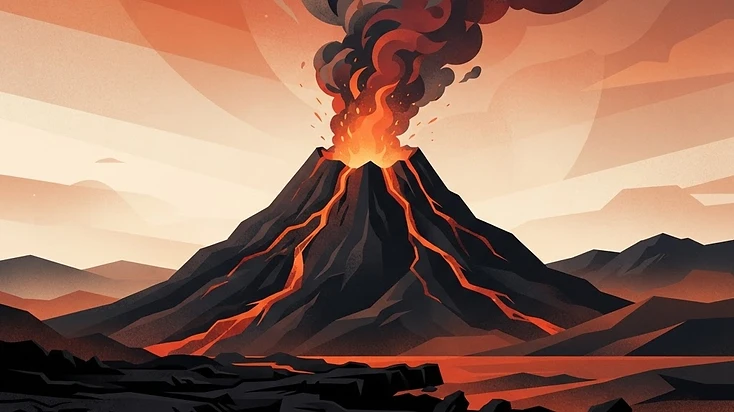
Volcanoes are the vents where molten rock, ash and gas escape from the mantle. They built most of the land we stand on, still add new territory every decade and drive some of history's sharpest climate shocks.
Play the Volcanoes quiz~1,500
Potentially active
80%
On the Ring of Fire
~45
Erupting right now
VEI 7
Largest since 1800
Why they erupt where they do
Almost every volcano sits on a plate boundary or over a fixed hot plume.
Subduction zones
One plate dives beneath another, melts and feeds explosive arc volcanoes — Japan, the Andes, Indonesia.
Divergent ridges
Plates pull apart and magma wells up; a 65,000 km (40,389 mi) chain of submarine volcanoes circles the globe.
Hotspots
A plume burns through the middle of a plate — Hawaii, Iceland, Yellowstone, the Canaries.
Rift valleys
Continents tearing apart, as in East Africa, produce long fissures rather than single peaks.
The five shapes
The style of an eruption is written into the shape of the mountain.
Stratovolcano
Steep cones of layered ash and lava — Fuji, Vesuvius, Rainier. The most dangerous kind.
Shield volcano
Broad domes of runny basalt — Mauna Loa is 4,170 m (13,681 ft) above the sea and about 17 km (10.6 mi) from its base.
Caldera
A collapsed magma chamber, often many kilometres wide — Yellowstone, Toba, Santorini.
Cinder cone
Small, steep piles of frothy fragments that form and die within a single eruption.
Fissure (laki)
Long cracks pouring out floods of lava, as at Laki in 1783 and Iceland's Reykjanes in 2021–24.
Eruptions that changed history
Ash and sulphur in the stratosphere can cool the whole planet for years.
Vesuvius
Buried Pompeii and Herculaneum under ash and pyroclastic flows.
AD 79
Tambora
The largest eruption in recorded history; 1816 became the 'year without a summer'.
1815
Krakatoa
Produced one of the loudest sounds ever recorded, heard 4,800 km (2,983 mi) away.
1883
Mount St Helens
A lateral blast flattened 600 km² (231.7 mi²) of forest in minutes.
1980
Pinatubo
Cooled global temperatures by about 0.5°C (32.9 °F) for two years.
1991
Hunga Tonga–Hunga Haʻapai
Shot a pressure wave around the world and water vapour to 58 km (36 mi) — a record.
2022
Did you know?
- Iceland sits astride the Mid-Atlantic Ridge, so it is literally splitting — the island widens about 2 cm (0.79 in) a year.
- Lava is not usually fast: basalt flows crawl at walking pace, but pyroclastic flows can exceed 700 km/h (435 mph).
- Volcanic ash is pulverised rock, not soot — it melts inside jet engines, which is why airspace closes.
- Around 800 million people live within 100 km (62.1 mi) of an active volcano.