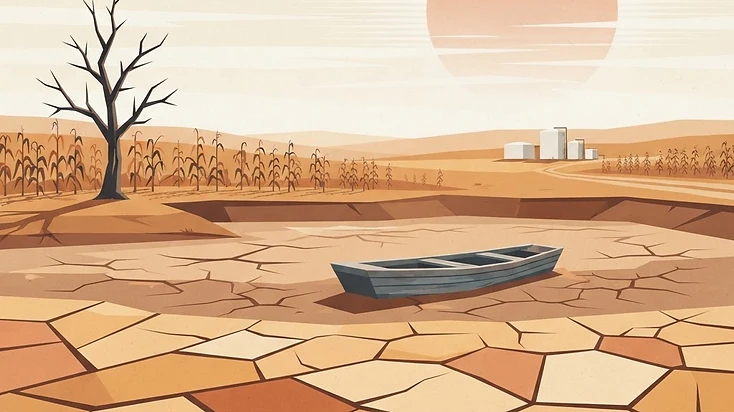
Drought is unlike every other natural hazard: it has no moment of onset, no clear boundary and often no end that anyone can point to. It builds over seasons and years, so by the time it is declared, the decisions that matter — planting, culling, rationing, migrating — had to be made weeks earlier. It kills more people globally than any other natural hazard.
Play the Drought quiz1.4 B
People affected since 1990
40%
Of the world faces water scarcity
< 250 mm
≈ 9.84 in
Annual rain defines dryland
5
Tipping point: 5 consecutive dry years
What drought actually is
Three different droughts are usually tangled together.
Meteorological drought
Simply less rain than normal for the time of year, over months or years. The first stage, and the simplest to declare.
Agricultural drought
Soil moisture falls below what a crop needs, even if reservoirs are still full. This is what harvests fail from — and it can begin weeks after the rain stops.
Hydrological drought
Rivers, lakes and groundwater drop. The slowest to arrive and the slowest to recover: aquifers can take decades to refill after being drawn down.
A flash drought
A new and dangerous category — heat and wind strip moisture out of wet soil in weeks rather than seasons, giving farmers almost no chance to adapt.
Not just low rainfall
Demand matters as much as supply. A drought hits hardest where the groundwater is already being pumped faster than it refills.
The knock-on effects
Water stress is where most of the damage starts.
Food and price shocks
Crop failure raises prices for people far from the dry region. Some of the largest civil unrest of the past two decades was triggered by wheat prices after poor harvests.
Energy and industry
Coal, nuclear and hydro plants all need cooling or flow. Utilities have been forced to power down because rivers were too warm or too low, not because demand was low.
Fire and dust
Dry fuels set the stage for the fire seasons in the previous topic; exposed soil becomes the dust storms that reach cities hundreds of kilometres away.
Displacement
Unlike a flood or a storm, people leave a drought slowly and often permanently — the hardest kind of migration to count or plan for.
The megadrought signal
The southwestern United States and the Amazon both appear to be in the driest stretches of several centuries — far longer events than the term 'drought' suggests.
Droughts that scarred the record
Multi-year events that rewrote societies.
Great Famine, India
Drought-driven famine killed an estimated 5.5 million people across the Deccan and the south.
1876–78
Dust Bowl, USA
Drought plus deep ploughing turned the southern plains into dust storms, displacing around 2.5 million people.
1930–36
Sahel
Twenty-five years of failing rains across the Sahel, with hundreds of thousands of deaths and a reshaping of rainfall patterns.
1968–93
Horn of Africa
The driest five consecutive seasons on record displaced more than a million people and left millions dependent on food aid.
2020–23
Amazon drought
Rivers reached record lows, stranding entire towns, while the region produced some of the largest fires on Earth in months.
2023–24
Western USA
Two decades of heat-driven megadrought that drained Lake Mead and forced the first-ever cuts to Colorado River allocations.
2000–
Adapting to less water
The practical answer is nearly always efficiency, not new supply.
Irrigation efficiency
About 70% of freshwater use goes to agriculture; converting flood-furrow to drip can cut the same crop's use by 30–50%.
Rainwater and greywater
Tanks, swales and planted roofs capture what does fall. In dry cities, the water that falls is often enough for gardens and toilets if it is stored.
Managed aquifer recharge
Deliberately soaking surplus flood water underground turns a flood problem into a drought reserve — the cheapest storage available.
Drought-resistant crops and pasture
Deep-rooted perennials, cover crops and mulch keep soil moisture through a failed season, where bare ground bakes it out in weeks.
Drought early warning
Combining satellite vegetation indices with rainfall and soil-moisture data lets agencies act weeks before crops visibly fail — the only time action is cheap.
Did you know?
- Drought has killed more people than any other natural hazard — far more than floods and storms combined.
- Groundwater is the hidden vulnerability: it is the buffer that keeps wells and rivers running, and it can take decades to refill after being drawn down.
- Dust from one continent can cross an ocean — the Saharan dust that reaches the Amazon is thought to carry nutrients that help it recover.
- A drought can be over in the meteorological record while still ongoing in the aquifer, so 'drought ended' headlines are often premature.
- Heat makes drought self-reinforcing: dry ground cannot cool itself by evaporation, so the next dry season starts from a hotter base.