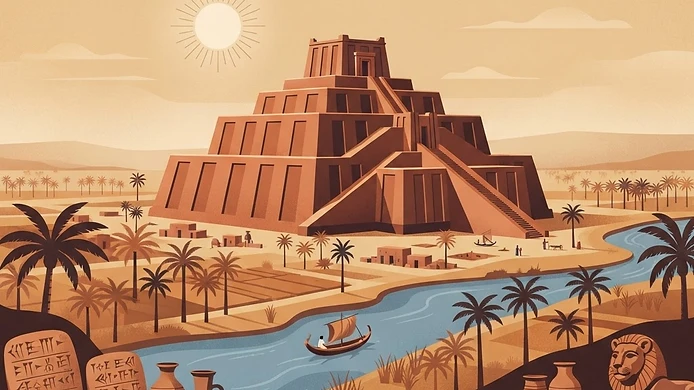
Between two rivers, farming villages grew into the world's first cities — Uruk, Ur and Babylon — where writing, the wheel and written law were invented.
Irrigation from the Tigris and Euphrates produced surplus grain, and surplus grain produced cities. By 3200 BCE Uruk held perhaps 40,000 people, its temple accountants pressing wedge marks into wet clay — cuneiform, the first writing, invented to record barley and beer. Kingship, the 60-minute hour, the 360-degree circle and Hammurabi's law code all trace back here, along with the epic of Gilgamesh and the first libraries of clay tablets.
Known for
the first cities and the invention of writing
- Cuneiform began around 3200 BCE as accounting, not literature
- The 60-minute hour and 360-degree circle come from Sumerian base-60 maths
- Babylon's Ishtar Gate was faced in glazed lapis-blue tiles
Civilisation Challenge
Question 1 of 8
When did Persian Empire flourish?
Time machine
500 BCEDrag through 6,500 years to see who was building, trading and fighting at the same time.
6 civilisations alive in 500 BCE
Ancient Egypt — c. 3100–30 BCE. Known for the Great Pyramid at Giza and hieroglyphic writing.
Ancient China — c. 1600 BCE–220 CE. Known for silk, paper and the Great Wall.
Maya — c. 1000 BCE–1524 CE. Known for a true zero, a 365-day calendar and stepped pyramid temples.
Ancient Greece — c. 800–146 BCE. Known for democracy, the Olympic Games and theatre.
Persian Empire — 550–330 BCE. Known for the Royal Road, underground qanats and a multi-ethnic empire.
Roman Empire — 509 BCE–476 CE. Known for concrete, aqueducts and a road network across three continents.
All 16 civilisations
In the order they rose. Tap any one to read its story.

The next civilisation
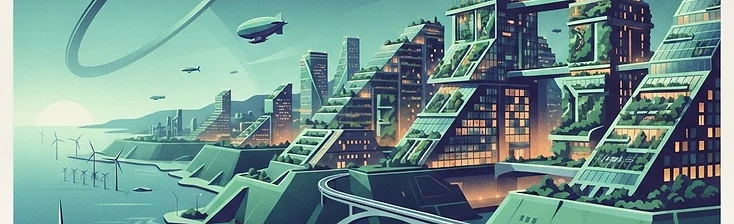
Play the Future Civilisation QuizSixteen civilisations have risen and fallen. The seventeenth is being built right now — out of cheap energy, ageing populations, machine intelligence, a hotter climate and the first real economy in orbit. Nobody can date it, but the forces are already measurable, so here is a reasoned forecast instead.
Population
10.3 billion (peak around 2084)
Living in cities
80%
Energy
Deep electrification, orbital solar pilots, synthetic fuels for flight
The century of growth ends and the century of maintenance begins: fewer young people, more machines, and the first serious money made in orbit. The question is no longer whether societies can expand, but whether they can keep what they built.
The forces already in motion
Energy
Solar and batteries keep falling in price, and fusion moved from theory to working machines in the 2020s. Civilisations have always been shaped by their cheapest power source — the next one is built on abundance rather than fuel.
Demography
World population is on course to peak around 2084 and then slowly fall. Most of the planet will be old: fewer workers, more machines, and migration pressure from the young regions to the ageing ones.
Cities
Roughly seven in ten people will live in cities by 2050, and cities — not states — are already the units that set climate, transport and housing policy. The next civilisation may be a network of city-regions more than a family of nations.
Intelligence
Machine learning is becoming general infrastructure, like electricity was in the twentieth century. Cognitive work is being redistributed faster than law, education or tax systems can adapt.
Climate
At least 1.5°C of warming is now locked in, and adaptation — sea walls, cooler streets, managed retreat, new crops — is becoming the main form of public works in this century.
Biology
Gene editing, synthetic food and longevity research are turning health into engineering. The ethical line between treating and designing is the argument of the next hundred years.
Three ways it could go
The Solar Republic
2050–2120 · the optimistic path
Cheap clean energy plus enough coordination to hold the climate line. Dense, green mega-regions linked by high-speed rail; declining populations stabilised by migration and automation; research bases on the Moon and a real orbital economy.
The Fortified Blocs
2075–2150 · the contested path
Climate stress and rivalry harden into continent-scale blocs with sealed borders, automated defence and adaptation walls around the richest cities. Technology advances quickly inside each bloc and barely crosses between them.
The Mesh
2100–2200 · the decentralised path
If energy is local and manufacturing is additive, power disperses. Bioregions and city networks coordinate by protocol rather than decree; the nation-state thins into a layer of standards, courts and shared data.
Signals to watch
- When clean power passes half of all electricity generated worldwide
- The year global population actually peaks — and whether fertility falls faster than expected
- Whether any major city completes a planned retreat from its own coastline
- The first city or nation to give machine systems a formal role in public decisions
- Whether orbital industry becomes commercially self-sustaining
- Which of these happens first: a climate pact with teeth, or a new cold war
Population figures follow the UN World Population Prospects projection of a peak near 10.3 billion around 2084; everything else here is scenario reasoning, not a prediction. Dates are guesses and deliberately wide.
Where to go next
Civilisations are one chapter of a much longer story. These pages and games carry it on.
Dates are conventional approximations, and several of these societies overlapped for centuries — the time machine shows exactly where. Illustrations are original artwork created for Nations Atlas.